Saturday, September 24, 2011
Street Music in Scotland
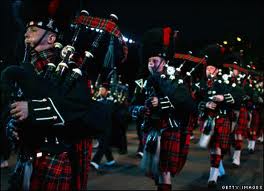
Each evening upon returning to our hotel in Edinburgh, we were greeted by the sounds of one of the more unusual “rock” bands I have encountered. The Spinning Blowfish include a drummer, a guitar player and a bagpiper. It was surprising how natural the three seemed to be creating a distinctive Scottish sound but with a rhythm and feel that was clearly rock and roll.
A large crowd had gathered, some with camp chairs, in the plaza of the Grassmarket section of the city, so named because it was where the cattle grazed before being sold. The street stage was also the site of many a public hanging over the centuries with those poor souls remembered by a marble cross next to Blowfish guitar case for contributions.
Street musicians seem to be everywhere in big cities these days. In Edinburgh, many were drawn by the Fringe Festival. Some to promote shows (the favorite trick seemed to be lying on on the street holding instruments in frozen poses with flyers scattered around) while others were busking where the crowds gathered on The Royal Mile. Every few hundred feet they were playing fiddles, pipes, guitars, horns and drums. In between were people juggling chainsaws, riding unicycles or doing card tricks. (I have no idea what the bearded man in the Wonder Woman outfit was up to.)
The sounds we heard on our travels varied between local light pipes and classic American rock and roll (at one pub along Loch Duich we heard the entire Tom Petty’s Greatest Hits during lunch). I suspect there is a Bagpipe Muzak Service for gift shops to keep the tourists in a buying mood.
In Glasgow the shoppers on Buchanan Street (recently re-opened after nearby areas had been dressed to look like Philadelphia for shooting scenes in the new Brad Pitt movie, World War Zed) drew more street musicians. A sax player did a pretty fair “Aint No Sunshine When She’s Gone.” Outside a subway stop we saw a fiddler who had attached a trumpet horn to his violin to amplify his sounds.
The American influence was prominent. Posters advertised an upcoming Brian Wilson show at the Glasgow Royald Concert Hall. The Oran Mar Theater (in a former church’s basement) advertised a cabaret show: A Bottle of Wine and Patsy Cline.
Back on Buchanan street, I felt sorry for a couple of tow-headed ten year olds on guitar and drums trying to be heard over a most unusual Scottish Band.
I think these guys were called ClairDonaigh but that is my rendition of their Gaelic CD title. I can report they were loud and I shudder to hear what they would sound like indoors at a bar like King Tut’s Wa Wa Hut up the street.
As for the Spinning Blowfish, I sprang the five quid for a CD so now when I am asked for the magazine ad: What’s on your Ipod? I can say: Scotland The Brave.
Sunday, September 11, 2011
The Bands of Battle in Scotland
Inside the ancient castle that towers over Edinburgh, Scotland, is a small chapel with stained glass windows and regimental books containing the list of names of Scots who lost their lives in wars around the world. The Scottish National War Memorial was opened in 1927, initially in honor of the 147,000 Scots who died in World War I.
Every summer for the past six decades, the bagpipers and drummers who have played the Scots into battle gather on the castle esplanade to perform the military music that can be haunting, rousing and even homorous at times. Today’s military tattoo is performed by a cast of nearly 1,000 in a temporary stadium packed with tourists drawn to the city for the theater and book festivals.
To some, military music is at best an acquired taste; to others, it is part of our cultural DNA, ingrained from years of Memorial Day and Fourth of July parades or as background to fireworks displays. Bagpipes also divide people sharply between fans and foes. There is no denying, however, that pipes and drums along with horns (and even strings) can be very stirring given the history of their roles on battlefields and at funeral services.
This year’s tattoo was surprisingly global with enough comdey to make the Disney folks take note. The first show stopper came when the music band of the Royal Netherlands Army rode into the arena on vintage bicycles, in World War I khakis, playing their instruments. Can you ride a bike and play a snare drum at the same time? While weaving in and out of crossing bicycles?
And who knew that the Brazilian Navy had a military band that included bagpipers? They were there and performed with Bossa Nova dancers in short frilly beach outfits. Not to be outdone the German Army Mountain Band from Bavaria brought along a synchronized wood chopping demonstration, four alpenhorns and an anvil (which they played).
Between musical numbers, there was a cannon pulling contest by teams from the Scottish Royal Navy and a (slightly hokey) reenactment of anti-piracy raid by sailors from the HMS Montrose.
Then it was back to music and marching, with three units from the Royal Marines who were joined by the Royal Highland Fusiliers, Royal Scots Dragoon Guards and finally, the other bands from around the world for the finale: The National Anthem, Auld Lang Syne and the Evening Hymn. Then from the ramparts a lone piper played A Parting Glass across the castle heights and across the years.
As the mournful sounds died out, the massed bands struck up a rousing march-out medley led by Scotland the Brave which had everyone ready to follow William Wallace with swords drawn.
Tuesday, August 9, 2011
How The Vinyl LP Founded The Rolling Stones
My summer beach reading (sans sand) has taken me back in time to the late 1950s when Keith Richards and I were listening to the same twangy guitars and the voices of Elvis Presley and Buddy Holly and The Crickets. Young Londoners attending the Sidcup Arts College with Keith couldn't get enough of American music and status was determined by who got the first releases of blues and (country) rock from the U.S.
In his autobiography, Life, Keith talks about how he listened to Ricky Nelson and the Everly Brothers but especially "The Chirping Crickets" and "A Date With Elvis", whose backup bands were Keith's first music heroes. Listening to a YouTube version of Elvis doing "I'm Left, You're Right, She's Gone," you can hear the progression from Texas-Memphis twangy guitar to "Sweet Virginia" (Exile on Main Street).
Even more interesting is Keith's wonder at the power of the music on vinyl:
"I’ve learned everything I know off of records. Being able to replay something immediatley without the terrible stricture of written music, the prison of those bars, those five lines. Being able to hear recorded music freed up loads of musicians that couldn’t necessarily afford to learn to read music, like me.
It was the emancipation of music...It surely can’t be any coincidence that jazz and blues started to take over the world the minute recording started, within a few years, just like that...I'don't need this paper, I'm going to play it straight from the ear, straight from here, straight from the heart to the fingers."
In Keith's version The Rolling Stones started at a chance meeting on a train in Darford Station in 1961: "Did we hit it off? You get in a cariage with a guy that’s got "Rockin’ at the Hops" by Chuck Berry on Chess Records and "The Best of Muddy Waters" also under his arm, you are gonna hit it off…..I realize now I’d met him once before outside Dartford Town Hall when he was selling ice creams for a summer job...he mentioned doing a dance doing Buddy Holly and Eddie Cochran stuff.
In a letter he wrote his Aunt Pat a few months later, Keith remembered that his calling card was also a Chuck Berry record. "A guy I knew at primary school 7-11 years, y'know, came up to me. He's got every Chuck Berry ever made, all his mates have too, they're all rhythm and blues fans.
When Keith decided to drop in at their regular Saturday morning juke joint, The Carousel, the rest as they say became history.
I can't help wondering two things. First was this the inspiration for "I'm Just Waiting for a Train?" Second, would there ever have been the greatest rock and roll band of all time if two young Londoners, instead of carrying bulky cardboard album covers (readable at long distances) had been listening to ipods with earbuds?
There is no doubt, you'll be hearing more Keith stories before the summer (and perhaps fall) is over because this a big book with lots of great stories and a terrific read.
One final anecdote from Keith's "college" days. He talks about how Sidcup produced a lot of great pickers because the musicians went to art school to hang out together. Wizz Jones was one of the best. He got "Cocaine" from Jack Elliott who got it from Reverend Gary Davis.
“Wizz Jones was a watched man, watched by Clapton and Jimmy Page at the time, so they say.”
Saturday, July 23, 2011
Local Gem Polishes National Treasures
We recently ventured out in the summer heat to hear a gifted pianist, singer, storyteller and musicologist present a grand tour of American popular music, a kind of "best of" sampler of Jazz, Broadway and Blues. I first heard John Eaton more than a dozen years ago when one of my basketball buddies (who grew up in Plainfield, IN) invited us to hear John perform at a local community center doing a concert called Indiana on Our Minds: The Music of Cole Porter and Hoagy Carmichael. He was as funny as Hoagy on the silver screen and his piano playing was as memorable as a Porter lyric.
On this recent night he began with "Lullaby of Birdland" and followed it with an anecdote about a gig in Georgetown when a guy who slipped onto the piano bench and started playing along turned out to be George Shearing. He introduced "It Might As Well Be Spring" from State Fair by saying Richard Rogers hated the jazz version. Then it was Ahmad Jamal's signature song, "Poinciana," written in 1936 and debuted by Glenn Miller.
Next up was a Jerome Kern medley from Show Boat that Eaton described as "no score ever written was greater or more melodic," a view affirmed by the fact that the musical's most recent Broadway revival came eighty years after it first opened. He began with "Make Believe," and "Can't Help Lovin' Dat Man" and by the time he got to "Ole Man River," which he slowed to a single note pace, you could feel the ghost of Paul Robeson on stage as the lyrics ran through your head.
Staying in the 1920's, Eaton made no attempt to sing Bessie Smith's version of "Nobody Knows You When You're Down And Out" but as he spoke the lyrics against the piano counterpoint, you got an instant lesson in what "talking blues" were all about. Ironic how those lyrics seem relevant today:
"So if I ever get my hand on a dollar again
I'm gonna hold on to it till them eagles grin"
Then it was a Bessie Smith version of "Empty Bed Blues" (When you get some sweet lovin,' don't tell no one else...they might get some lovin' too), followed by a Duke Ellington medley that brought the Steinway roaring to a toe-tapping finish. Eaton and bass player Tommy Cecil had given us a great musical ride.
Eaton (www.eatonpiano.com) has done public television shows on George Gershwin and Duke Ellington and his Smithsonian Conert Series have aired on public radio. In his introduction to the "Indiana" CD, Gary Burton described Eaton's work as "imaginative interpretations...and the keyboard wisdom of a true expert in the genre."
In another tribute to American pop music, Bob Edwards aired a July 4th interview with Philip Furia author of a number of books on Ira Gerswhin, Irving Berlin and Johnny Mercer.
He has also written American Songs: The Stories Behind the Songs of Broadway, Hollywood and Tin Pan Alley. Sounds like the perfect beach book.
Wednesday, July 6, 2011
A Capitol Fourth: Motown on The Mall
In Washington, D.C., when someone says, "Bring in da funk, bring in da noise!" it usually just means Congress is back in session. But this Fourth of July weekend, when the people took over the mall for fireworks and the Smithsonian Folk Life Festival, it was the real thing. This year's tribute to Rhythm and Blues featured some founding fathers (and mothers) of the modern music era. For me the main attraction was The Funk Brothers, another group of studio musicians who have shed the phrase "back-up" and become their own act, show band and even documentary film (with award-winning sound track).
Assembled in Detroit's Motown studios starting in 1959 they played for everyone that Berry Gordy invented or produced: The Temptations, Supremes, Martha and the Vandellas, Jackson Five, Marvin Gaye, Four Tops, et al. They were introduced as having played on more # 1 hits than the Beatles, Elvis Presley, the Rolling Stones and the Beach Boys combined. Numbers aside, the music they created has become part of our cultural DNA, from 45s to film soundtracks to television commercials. All they had to do was to hit the opening chords to "I Heard It Through the Grapevine" and the packed tent ooohhed and aaahed in anticipation of listening pleasure. The dance floor was jammed for hit after hit, from "Heat Wave" to "Dancing In The Street" and even audience tryouts for "My Girl" solos because everyone knows those lyrics.
Watching tourists and baby boomers boogieing in the 94-degree heat made me wonder if the Park Police had some ambulances idling nearby because "there aint no party like a Funk Brothers Party cause a Funk Brothers Party don't stop."
Earlier we caught a set by the legendary
We also sampled a few songs by Shirley Jones and the Jones Girls and Nat Dove and we stuck around for a glimpse of Swamp Dog (aka Jerry Williams) a Virginia native who quit his job as an A&R man for Atlantic records (Patti Labelle, the Drifters and Gary U.S. Bonds) for a solo career that produced what The Washington Post called "the fiercest, funkiest album the world still has never heard," Total Destruction To Your Mind. The title track opens with these lines:
Sitting on a cornflake
Riding on a rollerskate
Too late to hesitate or even meditate.
Always looking up what's down,
They've come to get me from the lost and found.
But believe me I'm feelin fine
To the world I toast some wine,
then
I do total destruction to your mind, mind, mind.
Swamp Dogg did not disappoint, appearing in a velour suit the color of lime green sherbet with matching fedora and tie.
It was great day for listening to music that not only made history but made you tap your feet and smile.
Thursday, June 23, 2011
Clarence Clemons: The Big Man Leaves the Band
I have been wondering why the death of Clarence Clemons has hung over me like a dark cloud. Every few days, there is an obituary about some music pioneer or rock and roll sensation who has died, the passing of a generation. But this event was somehow different and I have been looking back for answers.
As a fan of Bruce Springsteen and The E Street Band since before he was on magazine covers I have marveled at how his music has evolved, remaining thought-provoking and entertaining for decades. When Clarence brought his one-man horn section to the band, it was not just the straw that stirred the drink, it was more like a Waring Blender that mixed up the music to produce a new sound. From the guitars and drums and harmonica of folk rock, a big band sound emerged that produced the blockbuster album Born to Run.
The cover art for that gives the clue to the chemistry between the two front men: Clarence made Bruce laugh. I think he also could keep Bruce on an even keel even as he skyrocketed to superstardom. You just got the feeling that Clarence did not put up with bull---- from anyone (not even Bruce).
It seems in retrospect that Clarence's towering presence gave Bruce the cover he needed to keep experimenting and reworking his musical styles. His "partner, his friend" could be both a sounding board in the studio and the go-to guy on stage when the band needed a kick-start. And I wonder if back in the early days of playing in little seaside bars, that a lot of drunks thought twice about messing with the skinny lead singer when Clarence was on stage.
More recently Clarence became the big finish to Bruce's lengthy musical introductions of the E Street Band members ("and on bass, the man whose mother was a talent and whose father was a talent...Gary Tallent). He didn't have to remind the audience what instrument Clarence played, he just slid on his knees in front of the high priest in the temple of soul and rock and roll.
It was a good thing for Bruce and the rest of us that knee trouble kept Clarence from making it in the NFL and even though his passing seems to mark the end of the Glory Days for the rock and roll generation, his music can still bring back those memories.
Saturday, June 11, 2011
What makes a great song? John Hiatt on Treme
A recent episode of HBO’s Treme featured a “live” performance by a dapper John Hiatt of his song, Feels Like Rain, which resonates in the post-Katrina setting of the show.
Down here, the river meets the sea
And in the sticky heat I feel you open up to me
Love comes out of nowhere, baby, like a hurricane…
Feels like rain.
Almost as good as the cameo was the discussion that followed between Annie, the violin busker and her new mentor, Harley Watt. Annie says, “Good song.” Harley says, “Great Song.” For those who have not been watching Treme, Annie is trying to boost her career by writing songs but without much originality. Harley has taken her to see Hiatt for educational purposes.
As they walk home, Harley asks what was great about it.
Annie: The melody is simple, like the blues. It’s not locked into those chord changes.
Harley: Yeah, the music gives you what it can. Keep going
Annie: The lyrics not so simple. I mean it starts off and he’s singing about the weather, the river , the sea and you realize it’s New Orleans. But then he isn’t singing about New Orleans. It’s really love he’s got on his mind.
H: Okay
A: And love is not simple. It’s a little dark sometimes and a little dangerous—like New Orleans.
H: (laughs)
A: And he’s riding it out, no matter how rough it gets. He’s like us, now, after the storm.
H: Hiatt wrote that song 20 years ago darlin.' You still had training wheels on your bike and nobody had ever heard the name Katrina.
A: Really?
H: That’s what makes it a great song.
One of the ironies here is that Harley is played by a grizzled, grandfatherly Steve Earle, a pretty fair country singer-songwriter in his own right. The other is that it takes a television series by David Simon to give John Hiatt his due after all these years. (After some twenty albums, he’s gotten several Grammy nominations but no trophies.)
Hiatt, who was born about six blocks from where I went to grade school in Indianapolis, is one of those artists who is more revered by musicians and singers than the general public. It’s almost easier to list who has not covered his songs than the myriad of people who have: Bonnie Raitt (Thing Called Love) to Eric Clapton and B.B. King (Riding With the King) and Roseanne Cash (The Way We Make A Broken Heart) to The Neville Brothers (Washable Ink).
Wikipedia lists the following musical genres for Hiatt: Americana, folk rock, country, blues and Heartland rock. I would add comedy because he can turn a funny line (“We rolled that Camaro like a cowboy cigarette”).
Wikipedia does not include the fantastic collection of covers that Rhino released in 1993,
“Love Gets Strange.” It would be the perfect starter album for Annie’s songwriting 101 course.
Batten down the hatches
But keep your heart out on your sleeve
A little bit of stormy weather,
That’s no cause for us to leave...
Feels like rain
(Copyright Lillybilly Music 1988)
Subscribe to:
Posts (Atom)