Friday, March 30, 2018

Turnpike Troubadours In The Fast Lane


Very rarely do you come across a band whose lyrics play with your head and whose music kicks your butt.  That happened to me when I caught the Turnpike Troubadours on a recent “Austin City Limits” on PBS.

They ran me down with rollicking rockabilly music and then resuscitated me with some of the most ear catching lyrics I have heard in a long time.

The set began with with an upbeat ode to “Every Girl”  who evolved after breaks for fiddle, pedal steel and guitar solos from best girl to best friend. It begins with
She says she don’t believe in marriage
But she still believes in fate

And ends with
She’s a flighty good time buddy at the corner of the bar
But she’d fight the devil for you just for being who you are

Human emotions are the subtext of a weather report on “Tornado Warning,”
Kerosene to feed the flame
Your effect is quite the same
Shadows dancing on the wall
Waiting for the sky to fall

What hooked me for good was a moving-on love song, “Diamonds and Gasoline.”
And I would buy for you a diamond
Or myself some gasoline
If I can’t afford you darling
Then I can’t afford to dream

The small town love triangles and family dramas reminded me of the stories that John Mellencamp could whip up in three minute songs. But the Turnpike Troubadours give the tales of teenage angst the kind of sage ironic view of fortune’s ups and downs that John Prine can recall. They capture the feelings of the players while at the same time observing the chessboard they are playing on.


The band is presided over by lead singer (and song writer) Evan Felker who has movie star looks, a clear voice and stolid demeanor. He seems to be the axle around whom the rest of the band spins. In an interview after the show, he and bassist R.C. Edwards talked about how their use of recurring characters was influenced by William Faulkner and Stephen King. As Edwards put it, “they create their own little universes.”

Felker, mentioned the Red Headed Stranger as an example, “Essentially what I’m after is not having to create a concept record because I just like to mess around with these stories.”

Willie Nelson has obviously been a role model for their music style, a dance hall and cowboy bar sound that is reminiscent of “Willie and Family Live.”


Their backstory is as colorful as their lyrics. They began a dozen years ago in Tahlequah, Oklahoma and have been barnstorming at the rate of 100 dates a year since then, with five studio albums to date. They are criss crossing the country this summer from Johnny’s BBQ in Salado, TX to the House of Blues in Anaheim and Zoo Montana in Billings.

It promises to be fun.

We’ll raise another round boys and have another glass
Be thankful for today, knowing it will never last
Still let’s leave the world laughing when our eulogies are read
May we all get to heaven ‘fore the devil knows we’re dead.


Saturday, January 13, 2018

Johnny Cash, Moody Blues & Spike Lee


It's been an interesting musical week. It started with an impromptu Moody Blues retrospective, ended with a listen back to Johnny Cash at Folsom Prison and included a great story from Spike Lee about his father, bassist Bill Lee.

The Moody Blues concert was prompted by the passing of founder, Ray Thomas. The Moodies always seemed a little out of step with the musical trends of their day. Too smooth for rock and roll or even traditional blues, too much orchestration for purists and too cerebral for Top 40 radio. Still they had the chops and the talent to create their own sub genre and their own following that grew into a trend.
Their first big hit, "Go Now" in 1967 is a distant echo of their later orchestral symphonies and complicated rhetoric. But regardless of  the production values they added, they never lost the knack for a good hook. My personal favorite is from The Question,

It's not the way that you say it
When you do those things to me
It's more the way that you mean it
When you tell me what will be.

When it comes to interpreting lyrics, no one could do it better than Johnny Cash, especially in live shows.  (Of course he could pen some memorable ones as well.) So it's always good to hear him get his due as he has this week with stories about the 50th anniversary of his live album, "Johnny Cash at Folsom Prison." He took a big gamble to force Columbia Records to record and release it at a time when his career had fallen into one of its periodic eclipses. Boy did it pay off.

It's been a regular on my turntable several times a year since I found it a discount department store in the sixties for the nice price of $3.67. Listening to it again is like opening The American Songbook and realizing how the country-rock and alt-country got started and dozens of singer/songwriters owe him huge debts.


It's with some embarrassment that I admit that I never realized that Spike Lee's dad was a legendary bass player who wrote folk-jazz operas, scored Spikes' films and performed with Dizzy Gillespie and Duke Ellington. In a recent radio interview, Spike shared a story about what happened when Bob Dylan went electric. At the time Bill Lee was making a good living backing Pete Seeger, Judy Collins, Theodore Bikel and Dylan. It was his bass line on Puff The Magic Dragon, according to Spike.

 Bill Lee refused to make the switch to electric, on principle, and his work dried up to the point that his wife had to go back to teaching school to support the family. When Terry Gross asked Spike if he had any regrets about his dad's choice, Spike replied: "Never."


And finally, as long as we are remembering music legends, here's a story from Wayne Cochran, the legendary front man for The C.C. Riders with the eye-popping blonde pompadour. In the early 1980's, David Letterman asked him where he got the raspy voice needed to sing the blues.

"You gotta sound like you're hurting a little. I used to tell people, 'Just tie yourself to a donkey, let him drag you for about six months across a desert. When you stand up, you can sing the blues.'"


Saturday, August 12, 2017

John Mellencamp: Sprinting to the Finish


When John Mellencamp strikes the opening licks of a song, you know he's got you. He hits a musical nerve, opens a vein of nostalgia and salts it with irony, sarcasm and social commentary.
It is all on display during this summer's tour and on his exquisite new album with Carlene Carter, "Sad Clowns & Hillbillies."

He's put together a Show Band that is tighter than a tick and he marches it through his impressive hit parade with a precision that would make James Brown proud.  He begins in a bluesy country style with Lawless Times that showcases his aged-to-mellow gravel road voice. The musical path wanders smoothly from Small Town to Robert Johnson's Stones in My Passway.

But the crowd goes crazy when he turns the bend into Check it Out (all we've learned about living) and Jack and Diane(oh yeah, life goes on, long after the thrill of livin' is gone), the latter as an acoustic take with an audience singalong.


From there, it was onto another dreamer's tale off the new album. Grandview is Jack's story plus forty as he woos his girl with promises of a brand new double-wide trailer:
We could slide it on in there, honey
We can chock those wheels real good
I want it sittin' nice and level

He showcased two other new songs, My Soul's Got Wings and Easy Target, both arranged with more of a rock tempo than the country sound on the CD, lest the fans get fidgety while waiting for their favorites.

They came next,  after a beautiful piano and violin overture to Scarecrow: Paper in Fire, Crumbling Down, The Authority Song and Pink Houses (ain't that America... Cause the simple man, baby, pays the thrills, the bills and the pills that kill).

Mellencamp recently chain smoked his way through an interview with Jane Pauley on CBS in which he talked about reaching 65.
"I can see the finish line from here," he said. "I only have so many summers left and I intend not to waste them being old."

On stage he talked about how he and a long time band mate have decided to rest by only taking a lot of naps during the day. "I don't want the newspapers to say John Mellencamp died in his sleep."

Then he took us all back to those days

When a smoke was a smoke
And groovin' was groovin'
And dancin' meant everything
We we're young and we were improvin'

John Mellencamp, for one, still is--and still lighting musical fuses.


Saturday, July 15, 2017

Frightened Rabbit Wins The Race


We started the usual summer concert season in an unusual venue (DC's 9:30 Club) with an unusual audience (millennials) watching a band with an unusual name.
Frightened Rabbit may be the best up and coming rock band  you never heard of. Rest assured that many fans on the other side of the generation gap have, as the band has been selling out concerts from Boston to DC, and been on festival bills in Sonoma, Houston and Hyde Park, London.


Their U.S. swing in May was in support of their fifth album, Painting of a Panic Attack, whose title captures the complex psychological pathways of their songs. Those pathways are filled with twists and turns and a musical surprise around every hedgerow.
Rabbit's lyrics are introspective questions about how to cope with life and love but at this point, their teenage angst and fatalism have given way to a knowing world weariness, tinged by optimism. Founder and front man, Scott Hutchison, weaves some dark and torturous stories that somehow find a ray of hope at the end of the musical road.

Blood Under the Bridge
It's just blood under the bridge, and it's alright, it's alright...
I found the way to make the best of a flaw
And realize it's not the end,
It's just an uncomfortable pause.

Die Like A Rich Boy
I'll be Shakespeare's moonstruck king
We can lose our minds at the top of the hill
We burn cash and carry a decadent flame
Way into the night and beyond the grave.


Juxtaposed with these serious essays are rocket bursts of music from four guitars, drums and keyboards that have been playing together long enough to be polished without losing the fun of performing live. Hutchison keeps the audience entertained between songs with wisecracks about forgetting mates birthdays and how they're glad they did not move to California (from Glasgow, Scotland) because their songs would be "all happy and full of vitamins."

While their live show was a raucous, bouncing bar band romp, their studio CD comes across as a smooth, sophisticated production with an intensity that often delivers a wall of sound.

It's the words surfing in behind that sound which give Frightened Rabbit a lasting musical impact.  They capture the emotional push-pull of their generation and do it with a great back beat.

Get Out
I'm a worshiper, a zealot king, cursed, a devotee
Of the heady golden dance she does
She's an uncut drug...
I saw a glimmer in the dark and now I know
She won't get out of my heart, she won't.

Wednesday, April 19, 2017

Bee Gees: 50 Years of Great Hooks


The BeeGees First album has a place of honor in my collection because it is still fun to listen to and it confirms a couple of my personal theories. One is that first albums from a group are always the best. And second, that 1967 was the greatest year ever for rock and roll.


Perhaps I was smitten by the haunting lyrics of New York Mining Disaster 1941 (In the event of something happening to me...) or the anthemic sounds of To Love Somebody (You don't know what it's like...) that led to the powerful hook of the title phrase. Or maybe it was that their lyrics seemed more cerebral than their competitors in the British Invasion. Like Chad and Jeremy the word pictures made me feel as if I lived just around the corner from Carnaby Street and it was nearly tea time with Uncle Albert.

Those thoughts seem quaint in light of the super stardom that followed twelve years when Robert Stigwood asked them to write some songs for a John Travolta movie. That later period of history was served up in spades last Sunday on the CBS Grammy special honoring Barry, Robin, Maurice and in a backhanded way, little brother, Andy.

Even the Waring Blender processing that Grammy and CBS have taken to excess (glitz, celebrities, dancers, light shows) could not overwhelm the song writing genius of the Brothers Gibb. Unfortunately the show gave short shrift to the historic footage of The Rattlesnakes as teeny boppers in matching outfits in order to showcase people once nominated for a Grammy trying to imitate the sibling harmonies and showmanship of the originals.

Keith Urban did a creditable solo only to be let down by the sound mix on the crescendo line of To Love Somebody.  John Legend pulled off How Can You Mend a Broken Heart thanks in part to a sweet harmonica from Stevie Wonder. (How can you keep the rain from falling? How can you stop the sun from shining? What makes the world go round?). And the surprising a capella version of
Too Much Heaven from the Pentatonix was a treat.

As for the rest of hit parade, I preferred the real BeeGees who were captured for PBS cameras during the Las Vegas special in 1997, "One Night Only," which is on DVD and will no doubt be resurrected for future fund-raising weeks.


Travolta looked ageless on stage in his white sport coat and his anecdote about how the BeeGees came up with five songs during a weekend at a French chalet was charming. Each of those songs became a number one hit off the Saturday Night Fever soundtrack that was the biggest seller of all-time until Thriller bumped it off.

The mega single of the album, Staying Alive, has usually had a brassy, disco production and overdubbed chorus that all but drowned out the words. Now that the song has become a two word philosophy it is worth hearing the lyrics:

Feel the city breakin' and everybody shakin'
And we're stayin' alive, stayin' alive...
Life goin' nowhere. Somebody help me, yeah
Stayin alive

That epic hook seems to have its origins in the mine shaft first envisioned in 1967.

Have you seen my wife, Mr. Jones?
Do you know what's like on the outside
Don't go talking too loud, you'll cause a landslide, Mr. Jones.


Saturday, April 1, 2017

Patsy Cline: A Pioneer Voice


While the national media attention was focused on the passing of Chuck Berry, PBS was showcasing another music legend who changed the way we listen. "When Patsy Cline Was Crazy" is a combination of a traditional rags to riches story and some amazing video footage reminding us who paved the way for a generation of female performers.

Most of all, it brings back a voice that was powerful enough to cut through the static of AM radio, tinny jukeboxes and grainy television. If she had today's technology delivering her songs, the Sirens of Homer's Odyssey would have wilted with envy.

As Rhiannon Giddons reminds us, you always know that's a Patsy song.  Most of us know of her and her music but few know about her. This documentary from The American Masters series (pbs.org) narrated by Roseanne Cash, goes a long way to fill in the picture.

She started singing in bars and clubs while in high school, endured jobs washing Greyhound buses and drug store clerking before she got gigs with Roy Clark and Jimmy Dean. Her first record contract paid a pittance and stuck her recording the lousy songs the boss had the rights for.

Her big break came in 1957 when she appeared on Arthur Godfrey's Talent Scouts debuting "Walking After Midnight." As Arthur drawled, "Don't go away Patsy honey...you done won this."
That earned her $10,000 and forced the company to rush the song into stores where it became her first hit.


By then, Patsy had given up the Dale Evans cowgirl outfits with lots of fringe (made by her mother) for the kind of cocktail dresses seen on television variety shows. She was Nashville's response to Elvis and rock and roll and the shift paid off.

Before videotape the only way to preserve live television was by filming the monitors to make kinescopes and these are the highlights of the documentary. "A Church, A Courtroom, Then Goodbye," "Three Cigarettes and an Ashtray," and "I Fall To Pieces" are priceless performances that still sound heart-wrenching half a century later. As Reba McIntire admits, no matter how hard others try, "you just can't do it like Patsy."

There are other interviews paying tribute to Patsy as a scrapper, a trailblazer and someone who could do six shows a day for weeks at time in Vegas. Everyone from Willie Nelson ("Crazy" was named the #1 jukebox hit of all time) to Leann Rimes and Kacey Musgraves acknowledges their debt to Patsy.

Just as she hit it big, it all ended tragically in a plane crash in Tennessee in 1963, a month before "Sweet Dreams (of you)" was released. Twenty-five thousand fans lined the streets of Winchester, Va., during her funeral. They have been buying her music ever since.


The "Greatest Hits" album is  the longest charting record of all-time and has sold more than 10 million copies.  Each song has become a standard. Patsy Cline set the musical bar very high.


Tuesday, March 14, 2017

John Lennon's Legal Legacy


It is hard to imagine anything more valuable than John Lennon's musical achievements but to thousands of immigrants currently ensnared in the U.S. Customs and Border Patrol nets, it may be a court case he pursued and won more than four decades ago.

As our memories of how John and Yoko battled against the Nixon Administration have dimmed, a new book has arrived to remind us how corrupt politicians can threaten the Constitution, how individuals can fight back and how the legal system can actually deliver justice.

The story of John Lennon vs. The USA has been covered before on film and in print but there is nothing as riveting and cogent as the inside story told by his attorney, Leon Wildes, in a new memoir from the publishing imprint of the American Bar Association.


It is full of delicious historical ironies, scary parallels and inside gossip. It began in 1971 when Lennon agreed to attend a rally and concert in Ann Arbor on behalf of a radical writer and musician John Sinclair. Jerry Rubin, Rennie Davis and Bobby Seale were on the bill. Also attending were FBI agents who produced a 26-page report that got immediate circulation in field offices and the Justice Department. With a nudge from Sen. Strom Thurmond, John and Yoko became prime targets in the conspiracy against the anti-war movement. The plan to keep them from attending protests at the Republican National Convention in Miami in 1972 was simple and arbitrary: deny an extension of their temporary visas.

The Lennons wanted to stay, not to protest, but to continue their search for Yoko's daughter whose father had violated repeated custody orders and absconded with Kyoko. John, of course, was still making music and managing other Apple Records projects. His visa's Achilles Heel was a guilty plea on a cannabis oil charge in England (which has its own backstory).

They turned for help to Leon Wildes, a man who says he did not know who John Lennon was but he knew a helluva lot about immigration laws. They couldn't have picked a better guide down the rabbit hole of a parallel quasi-legal system (under the sole discretion of the U.S. Attorney General !) which has its own set of rules, its own system of appointed "judges" and its own arcane appeals process.

The trail winds through a fascinating Freedom of Information lawsuit, oral arguments at the U.S. Courtof Appeals, a clever public relations campaign, the birth of Sean Lennon  and some enduring legal precedents.

Wildes' breakthrough came when he discovered the Immigration Service had created an unofficial category to handle visa violators whom the agency did not want to deport for humanitarian reasons, in some cases despite felony records. These were called "non-priority cases," because the agency was willing to let them be ignored. Wildes found and analyzed more than 1,800 of these shadowy cases.
They became the basis for his arguments that the Lennons had been denied this status for political reasons, yet another Watergate tentacle.


In addition to describing how new legal protections were created, Wildes reveals how whip-smart Yoko was in anticipating the government's strategy against them, what a devoted family man John was and how his family has coped without him. It is a profile in courage worth remembering.


Tuesday, July 26, 2016

The Beach Boys Still Get Around


It’s Brother Love’s Traveling Salvation Show
Pack up the babies and grab the old ladies
And everyone goes, ‘cause everyone knows
Brother Love’s show

The only group on the Kennedy Center stage that has played longer than the Beach Boys was the National Symphony Orchestra, founded in 1931; but they were more than willing to share the stage with the kids from California.

At least this version of the band was still acting like teenagers (and making the audience feel the same)  while they were celebrating the 50th anniversary of the Pet Sounds album.

That tribute was to come later. First it was a greatest hits fest which included too many to list, including Surfin, Catch a Wave, Surfer Girl, Why Do Fools Fall in Love, California Girls, Little Deuce Coupe and I Get Around.

While some groups acknowledge their past, this one reveled in it with a video and light show that had film of Bruce Johnston actually surfing, Mike Love doing the Watusi, clips from every music show broadcast in the 60’s and enough bikini clad girls to fill several Sports Illustrated swimsuit issues. But the home movies (some of which matched the live singers with lip-synch from the original songs) contained enough self-deprecating humor and shared nostalgia that they seemed just another ride on the Beach Boys Roller Coaster.


The program called Love the “Captain” of this cruise which seemed appropriate as he led the band, sang harmony (he lets Jeffrey Foskett carry the lead vocals along with Brian Eichenburger) and joked with the audience and narrated the historical transitions.

The second set paid tribute to the Pet Sounds era with film of Carl Wilson singing on the screen above the live bands and Dennis Wilson also getting a solo bit.  Missing from the show was any tribute to Brian Wilson who travels with his own singers (and orchestra) in support of Smile. It was a subtle reminder of the Big Breakup that derailed the band just as they were doing their best work.

Caroline No, Sloop John B and Wouldn’t it Be Nice were done well and pleased the crowd. The show hit a speed bump when Mike brought out daughter Ambha for Warmth of the Sun and Bruce Johnston stumbled on Disney Girls, apparently unable to get his mic and earpiece working properly.

The Symphony was often drowned out by the band (playing in front of them) but their two marvelous overtures (Warmth of the Sun and In My Room) made me wish for an entire evening of the NSO’s take on the rich music that under girds the pop lyrics.

Love’s tribute to George Harrison, Pisces Brothers, was a wonderful surprise and showed he can still create new songs after all these years.

Music and memories are all that’s lost
Your songs are what go on and on.

The big finish had the crowd on its feet singing along with Kokomo, Help Me Rhonda (we didn’t need lyrics on the big screen for that, Mike) Good Vibrations,  and  Barbara Ann.  At the end we were having so much Fun, Fun, Fun, I had to break out my air guitar.


Friday, July 15, 2016

Boring Bob and Magic Mavis


It seems a shame you have to buy a ticket to Bob Dylan this summer to see Mavis
Staples but at least she is worth it.

Dylan’s never ending tour stopped at our nearby national park, Wolftrap, to show us  he is still up to his old tricks. Despite his opening number, “Things Have Changed,” he is still doing what he’s done for the couple of decades since I last saw him live. 


His band is tight and provides a wall of sound to which he adds his idea of barely intelligible narration.  It is as if he has become such a towering figure that all he needs to do is show up on set and read his lines, sounding more like Marlon Brando than the Frank Sinatra he is currently showcasing. One of the five Sinatra covers he essayed pretty much sums it up:

So let people wonder, let ‘em laugh, let ‘em frown
You know I’ll love you till the  moon’s upside down
Don’t you remember I was always your clown?
Why try to change me now.

It was Dylan’s old girlfriend, Mavis Staples who stole the show and our hearts with her smokey singing, her family anecdotes and wise-cracking with the audience. She began with a Staples Singers' call out, “If You’re Ready (Come and Go With Me).” We were and we did. After a cover of Talking Heads' “Slippery People,” she offered a brief mission statement:

 “I’m here to bring you some joy, some happiness, some inspiration and some positive vibrations.”  To do that she started with “Love and Trust,” which seemed painfully relevant to the week’s news.

The judge and the criminal, the sinner and the priest
Got something in common, bring ‘em all to their knees
Do what you can, do what you must
Everybody’s trying to find some love and trust.

Mopping her brow with a towel, she told us the next song was written by her father, Pop Staples for Selma in 1962.  Then she  had the audience side by side with her marching up Freedom’s Highway as she declared herself  “a soldier in this army of love marching for peace.” Her topical series wrapped with a richly nostalgic take on Buffalo Springfield’s  “For What It’s Worth.”

She closed with a rousing, extended version of the Staples Singers # l hit, “I’ll Take You There” which brought us to our feet clapping for the woman who proclaimed: “My Family has been “taking” you there for sixty-six years and I am not tired yet.”


Wednesday, June 29, 2016

Paul Simon's Dangling Conversations


These are the days of miracle and wonder

I would not give you false hope on this strange and mournful day

All my words come back to me in shades of mediocrity

Some people say a lie’s a lie a lie but I say why
Why deny the obvious child

The fact is most obits are mixed reviews,
Life’s a lottery, a lot of people lose

I would not be convicted by a jury of my peers

The nearer your destination the more you’re slip slidin’ away


As each drum rap or guitar riff  moved into a familiar tune, spreading another smile across my face, I said in recognition, “Oh just another classic.”  In fact the entire concert at Wolftrap Farm Park was a showcase of Rhymin’s Simon’s lasting imprint on American music.

Even the three new songs from his Stranger to Stranger album captivated the audience and Wrist Band might put him back on Top Forty Radio.  But the fans came to hear their favorites and Simon did not disappoint thanks to his limitless energy, still-strong voice and a tour band that threatened to blow the roof off the amphitheater. 


 These ten guys displayed some eye-catching versatility. At one point there were five people playing  guitars along with Paul. At another there were five people playing different drums.  And during one song alone the lead guitarist played a recorder and a saxophone between riffs. The result was a freshness and energy that made each song seem like it had just been released for the first time.

From The Boy in The Bubble to The Boxer, Simon led the musical parade down memory lane reminding us all that not only are his lyrics timeless but his music is always inventive and enthralling.

Homeward Bound was done as a little countrified waltz,  Spirit Voices was a mashup of Charles Ives and Aztec rhythms and You Can Call Me Al was an old fashioned barn burner that had the audience signing and dancing in the aisles.

Throughout the evening, I kept asking, “How can he top this?” and of course, he simply changed guitars and broke into yet another hit from his musical vault. By the time the saxophone solo punctuated Still Crazy After All These Years, the only response was more applause.


Simon has been bending our minds and mending our hearts with his special blend of ironic commentary, political anger and personal philosophy for at least half a century.  As he demonstrated on the stage and with his newest album there seems to be no stopping him. He is A Rock looking down on the sands of our times.

Friday, June 17, 2016

Joan Baez's Birthday Bash


Joan Baez cannot hit the high notes any more but she can still pluck your heart strings.
This contradiction made for a sometimes awkward, sometimes touching 75th birthday concert which aired on PBS’ Great Performances last week. The show (also airing online at www.pbs.org/wnet/gperf/joan-baez) featured what we used to call a Cavalcade of Stars (who could say no to Joanie?) and they performed the songbook of our lives as well as hers.

It featured everyone from Stephen Foster (Hard Times with Emmy Lou Harris) to Lennon-McCartney (Black Bird with David Crosby).  The casting was impeccable (Mary Chapin Carpenter on Donovan’s Catch The Wind and  Mavis Staples on Aint Gonna Let Nobody Turn Me Around)) but the execution showed more rust than diamonds.

It was hard telling what made this into a somber, funereal procession rather than a music party. She wore a black tuxedo and everyone seemed to have gotten a costume memo to wear black also. Song selections didn’t help. From God is God by Steve Earle, it was the mournful Phil Ochs’ There But For Fortune and even Freight Train seemed downbeat.

Mary and Emmy Lou, who are still in full voice, seemed to hesitate to take lead roles in their duets so they, along with Judy Collins, often struggled to find sync with Joan. 

After reminding people how she once sang Swing Low Sweet Chariot to awaken Dr. Martin Luther King from a nap (and performed it again at Woodstock) Joan chose to render it as a lullabye that must have caused some people in the Beacon Theater to nod off. You were hoping the stage curtains would part to reveal The Rebirth Brass Band to kick the song into high gear.

Mavis Staples tried to pick up the tempo but The Indigo Girls stayed in the background.
Richard Thompson was the next to genuflect on She Never Could Resist a Winding Road.


Queen Joan has certainly earned her title to folk-rock royalty with her voice and her undying devotion to political causes. No one has more battle stripes from singing on behalf of the poor and oppressed around the globe. Was there a civil rights or anti-war rally in the 1960’s and 1970’s (and most subsequent decades) that she did not headline?
Would there even be a Bob Dylan without her?

Jackson Browne got the party going with a touching, After The Deluge and Nano Stern surprised everyone with a rollicking, Gracias a la Vida.


Then Joan hit her stride when Paul Simon arrived (“We are talking serious legends department now, “ she quipped).  Their voices blended smoothly on “The Boxer,” and the crowd came alive as they sang:

And I am older than I once was
And younger than I’ll be
But that’s not unusual
No it isn’t strange
After changes upon changes
We are more or less the same.

Lie-la-lie…lie-la-lie…lie-la-lie

Tuesday, May 24, 2016

Guy Clark's Golden Hooks


Guy Clark was the songwriter who could whip out three words and leave you in a cloud of dust. You could also taste that west Texas dust in almost every song and there never seemed enough whiskey or wine to clear your throat.

It was Ohio State's Woody Hayes who famously extolled football's winning formula: three yards and a cloud of dust. Sometimes it took Guy more three words but he always won you over. The best way to pay tribute to him is to simply replay some of those phrases. He pretty much defined the "Outlaw" in modern roots music:

Desperadoes waiting for a train...

If I can get off of this LA freeway without gettin killed or caught.

And all that I learned from a Colt 45
Was to curse the smell of the black powder smoke
And the stand in the street at the turn of a joke

Then of course there were those fascinating, mesmerizing women

And the blues had a way with her smile
And she had a way of her own
Like prisoners have a way with a file

He always said that heaven 
Was just a Dallas whore

Hill Country, Honky Tonkin'  Rita Ballou
Every beer joint in town has played the fool for you
Backsliding, barrel riding Rita Ballou
Ain't a cowboy in Texas would not a ride a bull for you

Oh me, oh my how she makes that bow hair fly
How she hangs that music in the air

Then there was the company he kept. Townes Van Zandt, Lyle Lovett, Joe Ely, Rodney Crowell, Vince Gill and Jerry Jeff Walker and Rickey Skaggs among others. They are among many who would say to Guy Clark: Thanks for the songs.


Tuesday, May 10, 2016

VINYL The Book


One of the best parts of the HBO series “Vinyl” is the opening credits in which the mechanical cutting of grooves and the pressing of wax records are presented in slow motion close-ups worthy of Stanley Kubrick. No matter how often I have watched that or read about the process, I could never quite fathom how sound goes from electronic recording to wax grooves and back to sound waves created by a stylus and a turntable.

Then again I never appreciated how that process had driven the art of making music until I found the coffee table history, VINYL The Art of Making Records by Mike Evans (Sterling  Publishing). It is both a labor of love and a thing of beauty created by Evans, who started in Liverpool’s Cavern Club as a musician and has produced more than sixty books on music, movies and fashion.

If this were only a collection of album covers, it would be illuminating.  David Bowie’s foreshadowing of his sexual persona on Diamond Dogs.  Frank Zappa’s send up of Sgt. Pepper on We’re Only It For The Money.  Alice Cooper’s School’s Out as a wooden school desk (with the disc wrapped in panties). Rolling Stones’s Sticky Fingers (they had to unzip the fly because it was scratching the vinyl during shipment).

Evans starts with Marconi and takes us to the gold plated “Sounds of Earth” attached to the Voyager space craft (Mozart and Chuck Berry on the A-side) and into the current vinyl revival symbolized by Jack White.  The book is organized by decades with sidebars that include eye-popping Turntable Treasures, segments on live albums and features on major music events.


It is fascinating to learn how the push for long playing discs (33 1/3 with some 40 minutes of playing time) was driven by record companies who wanted to release classical performances on something more convenient than a stack of 78s (about four minutes to a side).
The first concept album? In Evans' view it was from 1955: Frank Sinatra’s In The Wee Small Hours.
The first double album? Bob Dylan’s Blonde on Blonde.  The idea of four different canvases ignited a revolution in cover art while giving the musicians twice as much recording time.
Motown’s first chart topping LP?  The 12-Year-Old Genius, the first of many hits for Stevie Wonder.


Mixed in with the rich history of blues, rock, rap and punk is an endless supply of trivia. LL Cool J is short for Ladies Love Cool James. Bill Haley’s Rock Around the Clock, which Decca released in 1954, sold an estimated 25 million copies. Sgt. Pepper took 129 days to make and was one of the first albums to print all the song lyrics.

Opening this volume is like uncorking a bottle of Chateau Margaux. You can’t decide whether to devour it all once or savor it sip by sip.


Tuesday, March 29, 2016

Bonnie Raitt: Gypsy in Me


Bonnie Raitt’s audience is aging but she isn’t. Between songs before a sold out Kennedy Center Concert Hall this weekend, she joked about her past and expressed amazement at still having fun making music.

“When I started doing this at 21, I never thought I would still being doing it at 66. But then I never thought Donald Trump would be running for President.” To that, a fan shouted: “Bonnie for President.” It would have been a landslide.

Raitt’s nearly two-hour concert was a walk down memory lane with side trips to songs from her new album, “Dig In Deep.” Against a Hotel California set, she rocked, crooned, mourned lost loves, played the blues, celebrated gospel music and kept up a running commentary. Recalling she was last at the Kennedy Center for an honors tribute to Buddy Guy, she noted, “Definitely not a juke joint this place.”


Her greatest hits seemed as fresh as the DC Cherry blossoms (which she had toured earlier): Something To Talk About, Working on a Love Letter, Right Down the Line, and a nearly acoustic version of Angel from Montgomery that sent chills down your spine.
After doing a similar lament from her new album, Undone, written by Bonnie Bishop, she quipped, "It was a lot of pain there. But I have learned after all these years I don’t  have to live every lyric.”

Raitt is one of the few performers who can segue smoothly from Sippie Wallace’s, I’m A Mighty Tight Woman to a Zimbabwean spiritual, Help Me Lord I’ m Feeling Low.  Often her transitions are respectful memories of songwriters and performers. Or she has a statement to make: “Money and politics so pissed me off, I had to do this one: Ain’t Gonna Take It. Then Shake it, Shake it, Shakin, carried its anti-nuclear power plant refrain: “Oh it makes me tremble.”


Her bandmates, including George Marinelli on guitars, Mike Finnigan on Hammond B-3 and piano, James Hutchinson on bass and  Ricky Fataar on drums are so good they distract your eyes from the star. That is, until, you hear this rippling riff and you realize: Whoa, that’s coming from Bonnie’s bottleneck guitar, of which she is a master. After all, she explained,“I did learn from John Hammond.”

This area has become a favorite of hers, thanks to the boost she and groups like Little Feat got from progressive radio station WHFS. “In DC people came to see us whether we had a Grammy or not.”


Her encore set captured the conflict of her music and everyone’s emotional roller coaster. I Can’t Make You Love Me (which of course we did) followed by That’s Just Love Sneaking Up On You.  With that the Gypsy Lady was on back on the luxury bus for the summer tour.


Saturday, February 13, 2016

Mick Jagger's "Vinyl" Valentine


When I started writing this blog five years ago, I had no idea that listening to music on vinyl was about to be catapulted from a thing of the past to a wave of the future. For me it was chance to wander through my record collection enjoying a few gems that had gathered too much dust while I went from cassettes to CDs. My trips down memory lane were prompted in part by a belief that the sixties and seventies were a golden age for rock and roll and the recent spate of books and movies about musicians and their music would seem to confirm that.

But I never expected that vinyl would become the mega-trend in music that it has. I have a relative who sells albums on the internet from Front Royal, Virginia. My friend John (who lives in Marin County...the Sun City for retired music people) sent me a story this week about the grand opening of a record store in Billings, Montana. The owner figured it was the only way he could clean out his basement with a clear conscience.

http://lastbestnews.com/site/2016/02/old-technology-aging-rockers-gather-at-new-vinyl-store/

Other friends have sent me stories about how the demand for vinyl records has brought the pressing machinery out of mothballs. The New York Times did a story on Luis Vuitton travel bags that included a box built specially for carrying LPs. Its profile of Sir Elton John reports that his vinyl collection has reached 3,000.


The next tidal wave in this trend will break on February 14 when HBO premieres a new series, "Vinyl," co produced by Mick Jagger, who has been working on the concept for more than a decade.

HBO is bringing out the big guns for this one. Martin Scorsese directed the two hour pilot episode and the show runner is Terence Winter who did "Boardwalk Empire" and produced for "The Sopranos." Set in the 1970s in New York City, the show promises, in the best HBO grittiness, to capture all the sex and money and drugs that went into fueling the rock and roll juggernaut.

No doubt there will be extensive analysis about how accurate this portrayal is; but it seems that HBO and its producers have made a major commitment to recreate the music of the era. The Times reports that there is a soundtrack album for each episode.

In other news about those rockers who came up in the '70s, the Indiana General Assembly (not usually known for its good works in recent years) has a bill pending to rename a section of Interstate 65 as "John Cougar Mellencamp Highway." The sixteen miles runs from Austin north to John's hometown of Seymour. The Indianapolis Star is sending a reporter to look for Little Pink Houses along the route.

Thursday, December 31, 2015

Dylan, Elvis, Otis & Sam's Stories


If I am finally too old to rock and roll (at least without risking major joint replacement), I can still celebrate the glories of musical yester-years thanks to the printed word. If 2015 is not the year of the book in music, it comes close. It might be easier to list the aging rocker who has not had a biography published than it is to itemize the new ones.

Recent arrivals have come from Tom Jones, Carrie Brownstein, Chrissie Hynde, Carly Simon, Tom Petty, Kim Gordon and Elvis Costello. Patti Smith has three volumes in rotation: Her award-winning memoir, “Just Kids,” a book of collected lyrics and a new personal history, “M Train.”

Dylan gets this year’s prize for the biggest volume. “Bob Dylan: All The Songs” by Philippe Margotin and Jean-Michel Guersdon may be the definitive encyclopedia (the story behind every song) but you will need to build a bigger coffee table to support it.
 It follows others this year, “Dylan goes Electric,” “61 Highways Revisited” (the albums), “Dylan Disc by Disc” and “Time Out of Mind.”

 If you are a fan, there is a book for you that adds some history and certainly extends the brand, if not the musical repertoire. I have a couple on my to-read list for the New Year. One is Mark Ribowsky’s biography of Otis Redding, “Dreams To Remember” with a chewy subtitle: Otis Redding, Stax Records and the Transformation of Southern Soul . Next is a holdover from last year, the strange saga of “Jerry Lee Lewis: His Own Story” by Rick Bragg.


Topping the list is Peter Guarlnick’s latest with what may be the most presumptuous title ever. “Sam Philips: The Man Who Invented Rock and Roll.” But wait, there is more: “And how he discovered Howlin’ Wolf, Ike Turner, Jerry Lee Lewis, Johnny Cash, Elvis Presley, and how his tiny label, Sun Records of Memphis, revolutionized the world.” Not many besides Guarlnick can make that stick but from what I have heard (NPR’s Fresh Air) and read (The New Yorker), he has the interviews and anecdotes to back it up. What’s even better is the book comes with a companion CD so he’s put his spin on which of these classic songs were lighting the fires of music revolution.

Finally the other eminent historian of this genre, Greil Marcus, issued a two-pack this year: On the 40th anniversary of the classic “Mystery Train,” he has a new edition. That was followed by the paperback release of “The History of Rock & Roll in Ten Songs.”


It’s nice to have a New Year’s Dilemma: Do I read?  Or listen?

Sunday, November 15, 2015

Ricky Skaggs' & Ry Cooder's Master Class


On their current tour these virtuosos have taken on new roles: Master Gardeners charged with preserving and protecting American Roots Music.  All their years of laboring in the  vineyards of country, bluegrass, and gospel have produced a vintage sound that was on display at the Birchmere in Alexandria, VA this week.

A set list that began with the Louvin Brothers’ The Family Who Prays  and ended with the Stanley Brothers’ Over in Gloryland might have foreshadowed a fire and brimstone tent revival. And at one point Ricky looked across the stage and asked “Ry, when you were growing up in Santa Monica did you think you’d end up playing bass in a gospel quartet?”  “Yes I did,” Cooder deadpanned.

But there was too much fun to be had on this trip down memory lane for anyone to feel pressured into baptism.  As they played and sang, it became clear that the longing for love and the need for spiritual sustenance are only separated by a few chords and a chorus.

They moved from Merle Travis (Sweet Temptation) to Hank Williams (Mansion on the Hill) to Stanley Brothers (Cold Jordan) effortlessly as changing guitars.


At one point, Cooder picked up what he called “a 100 lb guitar” that he had never played on stage before. The result was a rollicking duet with Skaggs’ mandolin on  Hold Whatcha Got with the audience singing along to the chorus:

Don’t sell the house, don’t wreck the car
Stay there, honey, right where you are
Hold whatcha got, I’m coming home to stay.

Cooder was similarly self-effacing when he strapped on a banjo that he said once belonged to Mike Seger and that he learned how to play it by watching You Tube videos.
Skaggs, his wife Sharon White, and Ry often suggested the audience turn to You Tube to hear the originals of the songwriters they were highlighting.

The legacies of Hank Snow (Now and Then There’s a Fool Such as I) and Lester Flatt & Earl Scruggs (Gone Home) are in good hands as these ‘young’ legends add their own lustrous versions to the country-gospel canon.

Rounding out the troupe was Sharon’s sister Cheryl on vocals, her father, 84-year-old Buck, on piano, Mark Fain on bass and Ry’s son, Joaquin Cooder, on drums.
When the road is called up yonder this band will be ready.

As for me, I heard the spirit listening to Ry Cooder’s solo intro to Tennessee Waltz. It is still ringing in my ears.


Wednesday, October 28, 2015

Beatles, Stones & Dylan in 1965


There are many ways to slice and dice music history. Andrew Grant Jackson does it by zeroing in on one year in his new book, 1965 The Most Revolutionary Year in Music. While some might counter that the Summer of Love or the first wave of Beatlemania were bigger, Brown lays out a convincing case.

The year began with Dylan’s Bringing It All Back Home, The Temptations’ My Girl and The Beach Boys Pet Sounds. It ended with the Beatles Rubber Soul.  Along the way, The Stones came up with Satisfaction, Otis Redding asked for Respect, James Brown announced Poppa’s Got a Brand New Bag,  and the Mommas and Poppas beguiled us with California Dreaming.  And that’s just for starters.

Throw in The Byrds, The Kinks, The Who, The Lovin’ Spoonful, The Animals, The Velvet Underground, Wilson Pickett, Barry McGuire,  Simon and Garfunkel and even a Sinatra comeback.

Fueling the creativity was the roller coaster of politics and violence of 1965: The assassination of Malcom X, Selma, the swelling tide of American troops going to Vietnam, Watts, Medicare and the Voting Rights Act.


Jackson has done his research (he has written two books about the Beatles) and has footnotes for every anecdote in this tapestry of exquisite rock and roll trivia. Here are a few examples.

--Stephen Stills flunked his audition for The Monkees TV show but recommended his friend, Peter Tork.

--Roger McGuinn discovered the Byrds’ signature 12-string sound after seeing George Harrison playing a Rickenbacker in Hard Days Night.

--Animals manager Mickie Most flew to New York to buy Brill Building songs from Don Kirshner, including “We Gotta Get Outta This Place” and “It’s My Life.” He passed on “Kicks,” which went to Paul Revere and The Raiders.

--Dylan road manager Bobby Neuwirth to Carole King: “You’re the chick who writes songs for bubblegum wrappers, right?”

There are also funny scenes such as Dylan turning the Beatles on to pot in a New York Hotel room  and how Johnny Cash started a 500 acre forest fire in California that cost him $82,000 fines for scattering 44 Condors.


Best of all is the way Jackson traces the creative process of the song writers and their times.  He devotes a chapter to how Satisfaction started with Keith Richards’ midnight guitar riff, evolved by a pool in Florida, went from folk song to rock during sessions in Chicago and LA and was completed when a roadie offered a fuzz distortion box to the band.

The result in Jackson’s words was how “…the Stones found their golden formula, mixing the beat of Motown, the lyrics of Dylan and Berry and the novelty of new technology to synthesize their own style of R&B/pop/rock.”

Jackson also documents how the sting of being booed at the Newport Folk Festival and the subsequent harassment drove Dylan into the studio where in three days he created Highway 61 Revisited. That escalated the music competition toward year’s end when Brian Wilson declared (after first hearing Norwegian Wood on his car radio), “We gotta beat the Beatles.”  Many people think he did, with his next album, “Pet Sounds.”


Sunday, September 13, 2015

Jackson Browne Quiet Superstar


Jackson Browne cuts a wide swath when he walks into town.  He plants one foot on the neck of today’s politicians and the other firmly in the romantic nostalgia of the 1970’s. He wears his progressive anti-war, eco-progressivism on one sleeve and his St. Augustine introspection on the other. Tying all this together is his timeless gift for melding music and lyrics in ways that beguile and provoke and strike emotional nerves.

Whether it is now (why so many live in poverty and others live as kings ) or then (longing for the legal tender), Browne moved seamlessly from his latest work on Standing In The Breach to his classic The Pretender throughout the evening.


The upscale audience was sitting on their hands until he moved to the piano and went to the first greatest hits segment. He woke them up with These Days and For Everyman  and after a dash back to the present with You Know The Night, it was into the vault with For  A Dancer and Fountain of Sorrow.

At the midpoint of a US tour, Browne’s band was tight as a tick and the lighting cues were faster than I could move my binoculars: Bob Glaub on bass, Mauricio Lewak on Drums. Jeff Young on Hammond organ and piano, Greg Leisz on lap/pedal steels and guitar (a 12-string for a Byrds tribute song) and Val McCallum,whose riffs on any one of his eight guitars would have been worth the price of admission.

This group gave Browne’s songs a distinctly country sound compared to his earlier studio albums and that reinforced the everyman images that his writing evokes.

Browne looks (and sounds) as if he stepped out of the 70s although his voice is deeper.  But he remains unaffected by fame (and 18 million albums sold), chatting with the audience about how he came to write songs like Winslow or how much he liked the venue: ‘This is a very special place to hear music, you can hear a pin drop.” It felt like he dropped into your living room to play a few songs.

His wry new take on life in Long Way Round (from “Breach”) echoed much of his more familiar work:
Now I’m a long way gone
Down this wild road I’m on
It’s going to take me where I’m bound
But it’s the long way around.

The segue to These Days defied the passage of so many decades
These days I sit on corner stones
And count my time in quarter tones to ten, my friend
Don’t confront me with my failures
I have not forgotten them.

The second set was just as strong a mix of the old and the new. The audience was on its feet for The Pretender and then drowning him out on the chorus of Running on Empty.

It is reassuring to see that Jackson Browne still has a tank full of high test emotions and that his songs still hold up a mirror up to our generation.

I’ve been aware of the time going by
They say in the end, it’s the blink of an eye
And when the morning light comes streaming in
You’ll get up and do it again
Amen


Saturday, August 1, 2015

First Aid Kit's Heavenly Harmonies


How I found myself watching two Swedish sisters, backed by a pedal steel guitar and drums, performing at a National Park just outside the DC beltway is an interesting story.
But the better one is about the music created and performed by First Aid Kit.

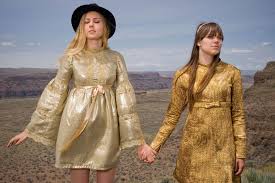
Karla Soderberg looks like Central Casting’s version of a singer songwriter from the 1960’s; her acoustic guitar and lead voice drive the band. Her older sister, Johanna, with long strawberry blonde hair and a sylph-like resemblance to a young Mia Farrow, plays keyboards and sings harmony. Their voices are strong individually but when they harmonize, you realize why ancient sailors would steer their ships toward the rocks.


The comparisons that come to mind (Everly Brothers, Parton-Harris-Ronstadt) do not seem adequate. When they chime in, the audience seemed to do a collective jaw drop and listen in amazement.

Although their voices could sustain them as a cover band, their song writing kicks up their work to a memorable experience. Here are some examples from their latest CD, “Stay Gold.”

What if our hard work ends in despair
What if the road won’t take me there
Oh I wish for once, we could stay gold.
What if to love and be loved’s not enough
What if I fall and can’t bear to get up
Oh I wish for once, we could stay gold.

Their ability to make sharp musical turns is showcased on “Heaven Knows” which starts with this melancholy opening reverie,

You’ve spent a year staring into a mirror
Another one trying to figure out what you saw
Paid so much attention to what you’re not
You have no idea who you are.

Then they flip the switch and out bursts a rocking dance-pop song with the chorus:
Heaven knows, Heaven knows, Heaven knows you’re lying. It will stick in your head for days.

They closed their set at Wolftrap Farm Park with an earlier song, Emmylou, a tribute to country music giants:
I ‘ll be your Emmylou/ And I’ll be your June
If you’ll be my Graham and my Johnny too.
I’m not asking much of you
Just sing a little darling, sing with me.

Their show-stopper came a few moments earlier when they sang Paul Simon’s “America.”  For two young women who describe themselves as coming from the land of snow, polar bears, Ikea and Volvo, they captured the spirit of going to look for America in a sound that was haunting and beautiful.


Two footnotes: The rest of the traveling band is drummer Scott Simpson from Edinburgh and pedal steel and guitar player Melvin “The Tiger” Duffy from Brighton, England.   Stay Gold was recorded in Omaha, Nebraska, which is what happens when you get
“discovered” in Austin, Texas.

This is one of my daughter’s favorite groups and when I persisted in referring to them as The Band Aid Girls, she got me the CD and that’s how I ended up at the concert.