Friday, April 27, 2012

FQF Trois: Sunpie & The Louisiana Sunspots


Reporter: It’s a story about the son of a sharecropper who grows up to play in a zydeco band.

Editor: Same old tale, what else you got?


Reporter: How about the guy gets a football scholarship, earns a degree in marine biology, has a stint playing pro football, becomes a U.S. Park Ranger, learns to play accordion and ends up as the poster boy for French Quarter Fest 2012.

Editor: Now you have my attention. What’s his name?
Reporter: Bruce Barnes, better known as Sunpie.

That was the conversation running through my mind as we sat in the performance studio on Saturday where we ended up during our tour of the U.S. Mint. We had seen the interview with a guy in a dark green National Park Service uniform being broadcast on screens in the hallway and followed the sound to the third floor.


On stage, a man was talking about his father (“Why you want to go play in a juke joint and get killed?”), his uncle who was a mule skinner along the Mississippi River and his Aunt Fannie who dipped snuff and like to give the kids a big sloppy kiss before expectorating.

Between stories, he played some of the seven instruments he has mastered, including piano and acccordion, and recreated the story of his hound dog hunting all kinds of game with his harmonica. Over the course of an hour, he regaled about fifty of us festival goers with stories and music that revealed a southern tale worthy of Faulkner.


One of ten kids (his father was 55 when he was born), he grew up on a truck farm in Arkansas and what free time they had they spent hunting and fishing. He ran track in school but switched to football in hopes of getting a college scholarship ( “Basically I was just trying to figure out how not to pick so many peas.”) Success on the gridiron at Henderson State led to a shot as linebacker for the Kansas City Chiefs and he jumped to the USFL when Donald Trump dangled the big bucks. After the league folded, he returned to his first love: the oceans and their habitats. As an NPS Ranger, he ended up back in New Orleans, still playing music with friends and bandmates from college days.

In 1989, he went into serious debt ($1250) to buy his first accordion. The next day, a friend told him about open auditions for a TV Commercial and said, “Bring your accordion.” One problem: Bruce didn’t know how to play an accordion. “I stayed up all night with that thing, until at last I could play one little song.” As luck would have it, the casting director asked him to play, he did, and beat out hundreds of others to star in a Sprite commercial. The fee for that paid off the accordion.

Several months later, frustrated with his progress, he went to see a music teacher in hopes of lessons. The teacher’s response was, “You are playing that upside down and backwards!” Bruce, who is left handed, had been able to pull it off; but he turned things around (unlike Rockin Doopsie who always played it in reverse, according to Bruce).

Sunpie got his nickname from Aunt Fannie because he used to follow his Uncle (the original Sunpie, a Crow Indian name) around as a little tyke. He became Little Sunpie.


Nothing little about Sunpie now, who stands about six feet four inches tall. Nothing small about his musical sound either as the group revved up the dancers at the Cajun Zydeco stage on Sunday afternoon. He and The Louisiana Sunspots (guitar, bass, two rubboard players who double on trumpets, drums and saxophone) can cover the musical waterfront: Domini, Money Bread, Choo Choo The Boogie, Luanne, Going Back to Big Mamou and more. They kept the dance floor full and brought the rest of us to our feet with some hot jams that went from blues to jazz to rockabilly. Sunpie's show was every bit as good as his back story.

Monday, April 23, 2012

French Quarter Fest Part Deux


Saturday morning we decided to do some museum exhibits which led us to the old U.S. Mint on the east end of the Quarter. It houses an exhibit on the early days of ore smelting/coin making and a jazz museum. We did a quick spin through a photo exhibit commemorating 50 years of Preservation Hall (Traditional Requests $1, Others, $2, The Saints $5) and then wandered into a third floor performance studio for a musical bit of lagniappe (something extra) that deserves its own post.

In the afternoon, we rendezvoused with friends on Bourbon Street for traditional New Orleans music with Jimmy LaRocca’s Original Dixieland Jazz Band. It merits the “original” title because it was founded in 1917 by Jimmy’s father Nick LaRocca, the tumpeter and composer of “Tiger Rag.” The original ODJB is reputed to have made the first jazz recording in 1917 and its version of “Darktown Strutters Ball” earned a slot in the Grammy Hall of Fame.

On this afternoon, they were as hot as sun on a sidewalk with “Momma’s In The Kitchen” and “War Cloud” then slowed down for a take on “It’s A Wonderful World.”

Around the corner in the courtyard of the Historic New Orleans Collection we came across another find: Andrew Duhon and The Lonesome Crows. He writes like a young Jackson Browne and has a voice reminiscent of Jim Croce. His ballads are about endless decisions on leaving or staying (I think it’s time to fit my life in my backseat/Got a girl I know that I can’t take with me) and the cover of his new CD has an open suitcase with a rope made of clothes with two hands hanging on.
His canvas is New Orleans but his characters are universal. “Coming Down Over Here”
captures the weather and a lover’s dilemma. (Babe, it’s been storming, at least it has so far. I seen the clouds forming but I didn’t think it'd be this hard.)

We stayed around for a set by Kristin Diable, a dead ringer for a young Joni Mitchell, but our group gave her mixed reviews; interesting songwriter but not much variety in her singing and playing.

After refueling at the Gumbo Shop, we caught the tail end of the Battle of the Bands on the steps of the old Courthouse, three traditional jazz bands who combined for a rousing version of “The Saints Go Marching In.” Among those dancing in front were two of the stars of FX’s Justified, Joelle Carter and Walter Goggins…two of those Crowders.

Then it was back to the waterfront for a final round of Zydeco with Donna Agnelle & the Zydeco Posse (“Aint no party like a Donna Party”) and Roddie Romero & The Hub City All Stars with a hot cover of a Fats Domino tune.

French Quarter Fest bills itself as the “ World’s Biggest Jazz Brunch,” with164 menu options from the Quarter's finest restaurants. We tried crawfish pies, shrimp cakes, lamb sliders, fish tacos seafood crepes and sweet potato fries, washed down with Abita Amber and Abita Jocamo (didn't try Purple Haze). We avoided Hurricanes and those college-kid drinks from Tropical Isle: The Hand Grenade, Skinny Hand Grenade, Tropical Itch and Happy Gator. Our restaurant tips include Acme Oyster House (barbecued oysters), Upperline (fried green oysters with shrimp remoulade), Mena’s Palace (best grits) Broussards (grilled red fish) and the Stage Door Canteen at the WWII museum (gumbo).

Next: The Sunpie Story

Thursday, April 19, 2012

So Much Music So Little Time


Walking down Canal Street to the Mississippi riverfront, the thought crossed my mind on the first day of the French Quarter Festival: How much music is too much? To diehard festivists, this might seem like aimless speculation. But for an aging fan, issues of stamina, decibel levels, sun exposure and sore leg muscles are lurking in the back of the mind.
Put another way, when faced with four days of shows…. 276 musical performances on 22 stages on a round trip circuit stretching almost two miles…how do you decide where to go? Unlike the larger Jazz and Heritage Festival, which has grown to Olympic proportions featuring national draws, FQF features local talent, most of whom were new to me. A lot of the venue/band selections would be rolling the dice. Did I mention that everything is free? Suffice it to say there are worse problems for music lovers than too many choices.

Day One. When in New Orleans start with Zydeco, which is what I did. After sampling the Bruce Daigrepont Cajun Band (for a Les Bontemps Roulez waltz), I checked in next door with Grayson Capps and Lost Cause Minstrels (“Take Some Poison Before You Die” and “Love Song of Bobby Long”). With a tie-dyed shirt, straw sombrero and a full mane of blond hair, he delivered pulsating blues-rock.

By the time I reached the Jackson Square stage, Luther Kent, a New Orleans fixture who once toured with Blood, Sweat and Tears was cranking up his blues: “If I could find just one good woman, I could get rid of the other 99,” and asking, “Can I get a beer up here?”(It was delivered in a few seconds from the front row.)

Then I retraced my steps back to the waterfront. Along the way I paused for a street (urchin) band…guitar, washboard and gutbucket base…calling themselves the Royal Street Gum Scrapers. At the Zydeco stage Amanda Shaw and the Cute Guys (not very but they could play some) had everyone up and dancing. As a fiddle player (red gloves and black and white stripe pants), she may not make you forget Charlie Daniels but will sure make him seem old. She first preformed at FQF at age 8.

For a grand finale, I let the Rebirth Brass Band play me out, or perhaps blow me away. They typify the modern style of these traditional bands, doubling up on the horns and with a microphone in the tuba shell they will vibrate your breastbone. Their merger of hip-hop and gospel call and response drew a huge crowd. I listened to them for almost five blocks walking back to the Quarter on Iberville.

Drawing a smaller crowd but just as much fun was the pickup group, I dubbed the Foot Locker Brass Band because they played outside the shoe store at night on Bourbon Street. They got my two bucks.

Day Two. Armed with camp chairs and sunscreens we again began at the Zydeco stage with Jomo and Bayou Deville and got rocking with The Soul Project covering James Brown, “I Can’t Stand Still,” At Jackson Square it was another New Orleans institution, Banu Gibson, doing songs from Bessie Smith to George Gershwin. Her trombone player in The New Orleans Hot Jazz, who is 81, offered these words of advice he picked up while playing with Lawrence Welk: “Act like your having fun but don’t have any.”

It was traditional jazz at the Farmers’ Market Stage with The New Orleans Cotton Mouth Kings doing Driving Miss Daisy (She’s Driving Me Crazy) and getting everyone to sing along with My Blue Heaven.

Back along the river at the Louis Louis Absolut Stage we made our first real find. Not sure if it was the large crowd of locals or the sound of his lap slide guitar but we were hooked on a blues player named Colin Lake.


Whether it was doing traditional songs like “I’ll Fly Away” or his own compositions, “Where Did We Go Wrong,” and “In On Time,” the crowd loved it and so did we. His new CD is “The Ones I Love."

With some regrets we cut our stop with the Pine Leaf Boys short because in New Orleans, you do not want to miss dinner.

Saturday, March 24, 2012

BB, Mick and Barack: Blues at The White House


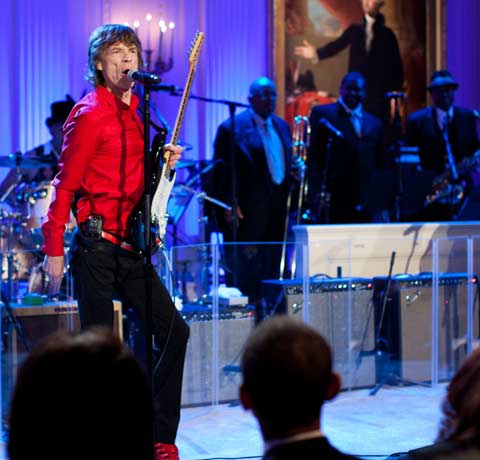
It had to have been the smallest crowd that Mick Jagger had played to in decades when he headlined the recent “Red Hot and Blues” concert from the East Room at the White House. But it may have been the best all-star blues band he has ever fronted.

Of course, the First I-Pod stole the show when he sang the chorus of “Sweet Home Chicago” with B.B. King as a finale. And he showed his professorial roots with an introduction that began with a nod to Alan Lomax paying Muddy Waters $20 for two recordings in 1941. He also noted that the blues represented “music with humble beginnings, with roots in slavery and segregation in a society that rarely treated black Americans with the dignity and respect they deserved.”

The concert, broadcast on PBS and with clips still streaming at their website (http://www.pbs.org/inperformanceatthewhitehouse/video.php), was a chance to pay respect to the troubadors of pain and poverty who have made this musical art form into a hallmark of American culture.

It began with the grand master, B.B. King doing “The Thrill is Gone,” and then the other senior statesman, Jagger, got the spotlight for several songs including, “Commit A Crime” by Howlin Wolf, with Jeff Beck on guitar.

Jagger paid his respects to the pioneers when he talked about the Rolling Stones’ first visit to Chess Records in Chicago in 1964 and meeting Muddy Waters and Willie Dixon, among others. And he had a corny joke about Sonny Boy Williamson (“These English boys want to play the blues real bad. And they do…play it real bad.”) But Mick, under the watchful eyes of George Washington and Teddy Roosevelt, could still make the ladies swoon and the men try to figure out how he does it.

Looking like a Harvard professor himself, was another veteran, Booker T. Jones, who presided with aplomb over his band from behind the Hammond B-3 organ.

For me, the excitement was generated by the younger folks on the card. People like Trombone Shorty doing “St. James Infirmary,” Gary Clark, Jr. doing “A Beat Up Guitar,” Keb Mo doing “Henry,” and Susan Tedeschi, Derek Trucks and Warren Haynes in a very credible tribute to Etta James on “I’d Rather Go Blind.”

But when the heavyweights joined forces, the guitar riffs were jaw dropping. Jeff Beck, Gary Clark, Jr., and Buddy Guy (with Mick) brought the house down with Eddie Boyd’s,
“Five Long Years.”


It was night when the price of admission seemed to be a bottle neck on your ring finger, and made you think there had not been this much musical talent under the White House roof since Thomas Jefferson dined alone.

Saturday, March 3, 2012

News & Notes: Grammys to Glasgow


As this blog enters a second year, and the televised awards season has washed over us, it seems appropriate to do a little reflecting on recent events and past posts. Let's start with The Grammys, which, despite the politics and the pandering (why do so many TV stars and sports guys get to present music awards?) and the endless commercials, still manages to put on pretty good show. For a show that gives aural accolades, it does some stunning production numbers and eye-catching visuals. You gotta love the slide shows of waves and surfboards behind the Beach Boys songs and how pale the setup bands seemed when compared to the real thing. “Good Vibrations” still sounds like a work of genius and it was touching to see Brian back with the band after all these (50) years. (See April 14, 2011 post).
It was a night for us seniors and those even older who were still performing. What a contrast between the simple solo of Sir Paul McCartney and Tony Bennett’s duet with the complicated production numbers of Taylor Swift and Katy Perry. Speaking of Taylor, didn’t she look fetching in her shredded dress plucked from a Tobacco Road shack? She sure looked different in the Cover Girl Ad that followed later! And it was ironic to see Sir Elton John in a Pepsi spot and not on stage.
The tribute to Glenn Campbell (Blog Post Feb. 21) seemed just a year too late as he stumbled a bit and the set-up bands made me want to reach for the original versions by Glenn and John Hartford. It was still a grabber when the Rhinestone Cowboy sang,
“There’s a load of compromisin’ on the road to my horizon.” One heck of a long road.
One other line deserves mention from the humble Bonn Iver, winner of Best New Artist, when he said, “I want to thank all the nominees and the non-nominees.”

Between glitzy award shows we spent a lovely afternoon watching sets from the performers at a memorial tribute to the late financier Warren Helman. It was streamed from the Hardly Strictly Bluegrass site (http://www.strictlybluegrass.com/) and was great fun to see as well hear favorites like Steve Earle. Gillian Welch and David Rawlings wore matching red and white satin, rhinestone studded outfits that seemed as sassy as their line from Miss Ohio, “I want to do right but not right now.”

The folk songs sounded especially good coming out of the vintage KLH 17 speakers that are still strong after all these years. (A tip of the hat to my daughter who insisted we needed a cable so she could listen to her computer collection when she is here visiting).

One other note from the concert (which may still be up and streaming along with the service for Warren) came from the Dry Branch Fire Squad who announced that they had CDs for sale in the back. However they only had 12 of the Dry Branch Fire Squad Thought Repellent Hats left. “The one man looking at them must be a Hoosier and we appreciate his support.”

Speaking of daughter Jessica, her latest parttime job is being a minder for two boys, ages nine and ten, who are playing the young Tommy in the Rock Musical, “Tommy” (Blog Post December 25) which the graduate students at the Royal Conservatoire in Glasgow are presenting. She still has a tee shirt from the Broadway production of “Tommy” we took her to when she was too young to appreciate anything but the music.

Finally, a RIP to Davey Jones (Blog Post January 22), who was on the Ed Sullivan Show the night the Beatles appeared and said it changed his life from stage to singing. I have been amazed at the media attention his passing received and wonder if it is because of his young age (a boomer plus one) or perhaps just all the fun he created on screen that we wish we had back.

Friday, February 17, 2012

Guitar Man: Happy Traum


There’s 1352 guitar pickers in Nashville
And they can pick more notes than
The number of ants on a Tennessee ant hill.

There’s 1352 guitar cases in Nashville
And anyone who unpacks a guitar
Can play twice as better than I will.
"Nashville Cats"--John Sebastian.


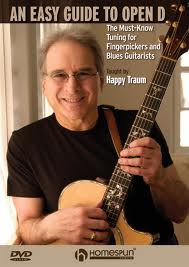
The other night I happened across a guitar player who not only plays twice as better than most, but can probably take credit for teaching many of the cats in Nashville and other cities how. The venue was Schoenberg’s Music shop (www.om28.com), a tiny place in the picturesque town of Tiburon, located on a point halfway between the Golden Gate Bridge and San Quentin.


The star attraction was Happy Traum, a bona-fide folk legend who began in the early sixties in New York’s Washington Square and whose guitar skills and easy manner led to teaching handbooks and videos that are still in print today. My friend, host and flat-picker John still has his Happy Traum instruction books.

Traum acknowledged his musical roots with a tune, “Betty and Dupree,” by his teacher, Brownie McGhee (with whom he did an instruction book). He then told a story on himself about performing a folk song he “discovered” that turned out to be “The River is Wide.”

Traum’s first recording was for Folkways Records, called Broadside Ballads, Vol. 1, a collection that included Bob Dylan, Pete Seeger, Phil Ochs and others. Traum’s New World Singers were the first to record “Blowin’ In The Wind” and he recorded a duet with Dylan (who used the pseudonym Blind Boy Grunt).


Traum paid tribute to Dylan as a song writer and bluesman repeatedly throughout the evening with “Crash on the Levee,” “I’ll Be Your Baby Tonight,“ "Buckets of Rain” and
“Tonight I’ll be Staying Here With You.” After that last one, he remarked slyly,
“Whoever wrote that song is going to go far.”

Traum’s singing voice is no longer as robust as it was in the early 70’s but when he dials the lyrics back to almost a talking blues, it lets the music and his guitar virtuosity shine through, easily heard in a such a small room. Imagine Andres Segovia doing a set of Dylan covers.

Joining him for the evening was his son, Adam, who could match his father, chord for chord and they played well off each other. Adam is working on a new album with his dad and old family friend, John Sebastian (who appeared along with Roly Salley on Happy’s solo album, American Stranger done back in 1976 and now re-released.)

There was more music from Mississippi John Hurt’s “Monday Morning Blues” to Steve Earle’s “Hometown Blues.” There was also a great vibe from the aging baby boomers in the audience, half of whom raised their hands when Happy asked: “How many of you play?”

Finally, it was a beautiful visual setting to see a man and his son, both of whom had devoted their lives to making music from simple, acoustic guitars, performing in front of a wall of Gibsons and Martins built in the 1920s and 1930s. The fruits of artisans striving to create the perfect instruments and the efforts of artists to play them to the fullest measure.

Sunday, February 5, 2012

Music Milestones 2011: Teen Spirit to King Tut


Advancing age, no doubt is what makes me appreciate anniversaries and the passing of those who made a difference in our lives and culture.

Let’s start with some anniversaries and reappearances. It was thirty years since the debut of a music cable channel, chronicled this year with the publication of a book, “I Want My MTV.” It was the was 20th anniversary of Nirvana’s “Never Mind” which drummer Dave Grohl observed by releasing his seventh Foo Fighters album and a documentary film, Foo Fighters Back and Forth. Another film by Cameron Crowe for PBS celebrated 20 years of Pearl Jam. DC punk rockers, Fugazi proved you can be on hiatus and on the internet by releasing the first of some 800 recorded concerts for download on a pay what you can basis. They Might Be Giants marked 25 years with a new release.

Other comebacks included The Cars after 22 years, Aretha with a CD sold exclusively at Wal-Mart and banjo player Steve Martin, whose album of original compositions with the Steep Canyon Rangers (along with Paul McCartney and The Dixie Chicks) reprised his mega-hit from 1978, King Tut. There were a number of tribute albums, including cover collections of Buddy Holley, Hank Williams and Waylon Jennings. Woody Guthrie’s family continues to mine his archives for new collections.

Most rock bands break up more frequently than they change socks but R.E.M. made it 31 years, leaving a legacy that both musicians and wordsmiths can appreciate.

The year saw the passing of many music stars. Here are some you may have missed.
• Jean Dinning, who wrote “Teen Angel” and recorded by her younger brother Mark.
• Gladys Horton, an original Marvellete whose “Please Mr. Postman,” was Motown’s first number one hit.
• Hazel Dickens, blue grass champion of the working poor who wrote “Mama’s Hand.” Her haunting voice graced the soundtracks of Harlan County, USA and Matewan.
• Gil Robbins, a member of The Highwaymen and father of Actor Tim Robbins. He began his career as drum major for the UCLA marching band, was a backup singer for Harry Belafonte and later managed the Gaslight CafĂ© in New York City.
• Don Devito, a record producer who did Dylan’s “Blood on the Tracks” and “Desire.”
• Sylvia Robinson, who as part of a duo, Mickey and Sylvia recorded the 1957 hit, “Love is Strange” and then produced, 22 years later, the first hip-hop single, “Rappers Delight,” which sold 14 million copies for her Sugarhill Gang label.
• Tom Keith, the incomparable sound effects man for Prairie Home Companion.
• Hugh Martin who composed songs for Judy Garland to sing in Meet Me In St. Louis and penned these classic lyrics:
“Have yourself a Merry Little Christmas/ Let your heart be light
From now on our troubles will be out of sight.”

The year 2011 saw Tom Waits, Darlene Love, Alice Cooper, Dr. John and Neil Diamond enter the Rock and Roll Hall of Fame. Diamond was also feted by the Kennedy Center along with Sonny Rollins and YoYo Ma.


The Smithsonian announced that it has rescued the last replica of Parliament Funkadelic’s Motherhip and will put it on display at the National Museum of African American History when it opens in 2015.

Bob Dylan performed in China after agreeing not to sing several songs including, “The Times They Are a Changing” and “Chimes of Freedom.”

Finally, a fond farewell to financier and music lover Warren Hellman who, in 2001 founded the Hardly Strictly Bluegrass Concerts in San Francisco’s Gold Gate Park. The free concerts showcased hall of fame talent and his philosophy about philanthropy:
“Money is like manure. If you hold on to it, it stinks. But if you spread it around, good things grow.”